
Struggling to save money even with a steady income? Discover the real psychological and practical reasons why saving money feels hard and learn simple, effective strategies to make saving easier.
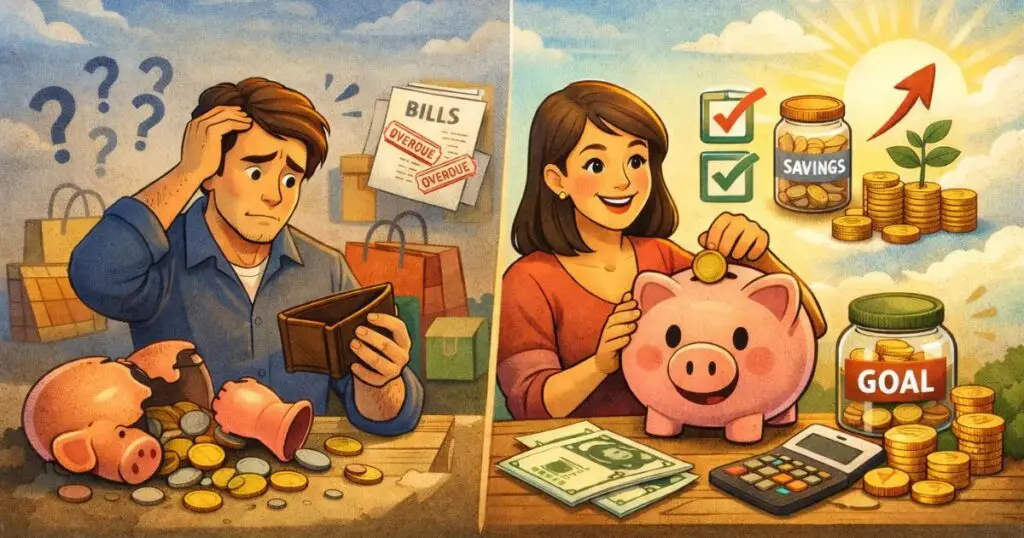
Saving money seems like a simple idea.
Earn money. Spend less. Save the rest.
Yet for millions of people, this “simple” formula never works in real life. Every month begins with good intentions and ends with the same question:
“Why do I still have nothing left to save?”
If this feels familiar, the problem is not that you are careless or irresponsible. The real issue is that saving money goes against natural human behavior, and most people are never taught how to build systems that make saving automatic.
This article will help you understand why saving money feels so difficult — and more importantly, how to make saving easier without feeling deprived.
🧠The Psychological Reasons Saving Money Feels Hard
Saving money is not just a financial challenge. It is a behavioral and emotional challenge.
1️⃣ Your Brain Prefers Instant Pleasure
Spending money gives immediate satisfaction:
- Eating your favorite food
- Buying something new
- Going out with friends
Saving money gives future security, but no instant emotional reward.
Your brain naturally chooses:
Pleasure today ❌ over safety tomorrow
That’s why saving feels like sacrifice, while spending feels like enjoyment.
2️⃣ Saving Feels Like Losing, Not Gaining
When you move money into savings, it feels like that money is “gone.” You can’t see it, touch it, or enjoy it immediately.
Because of this, your mind sees saving as:
“Money I can’t use”
instead of
“Money that protects my future”
This mental shift is crucial. Saving is not losing money — it is paying your future self.
3️⃣ No Emotional Reason to Save
People save more effectively when they have a clear and emotional goal:
- Protecting family during emergencies
- Buying a home
- Creating financial independence
- Reducing stress about money
But if saving is just “something I should do,” motivation fades quickly.
Money saved with purpose feels meaningful.
Money saved without purpose feels like restriction.
4️⃣ Lifestyle Increases with Income
This is known as Lifestyle Inflation.
You get a salary raise →
You upgrade your phone →
You start eating out more →
You spend on better clothes and subscriptions
Your income increases, but your savings don’t. Your lifestyle simply grows to consume the extra money.
Without conscious control, income growth improves comfort — not financial security.
5️⃣ Saving Is Treated as an Afterthought
Most people use this formula:
Income – Expenses = Savings ❌
But expenses are flexible. They expand to fill available income.
Saving only “what’s left” usually means saving nothing.
💡 Practical Reasons Saving Becomes Difficult
Beyond psychology, daily life also creates barriers to saving.
🔹 Irregular Expenses Surprise You
Car repairs, medical bills, school fees, festivals, travel — these expenses don’t happen every month, but when they come, they destroy savings.
Without a buffer, every surprise becomes a financial shock.
🔹 Easy Digital Payments Increase Spending
Online shopping and digital payments reduce the “pain” of spending. Money leaves your account silently, making overspending easy and invisible.
🔹 Social Comparison Creates Pressure
You see others:
- Buying new gadgets
- Traveling
- Upgrading lifestyles
And you feel you must keep up. But you rarely see their debts, loans, or financial stress behind the scenes.
✅ How to Make Saving Money Easier (Without Feeling Restricted)
✔️ 1. Pay Yourself First
Change the formula to:
Income – Savings = Expenses ✅
The day your income arrives, transfer a fixed amount to savings before spending on anything else.
When savings happen first, they don’t depend on willpower.
✔️ 2. Give Your Savings a Purpose
Rename your savings accounts:
- Emergency Fund
- Future Security Fund
- Family Protection Fund
When savings have meaning, motivation increases.
✔️ 3. Start Small, But Stay Consistent
Many people delay saving because they think the amount is too small.
But consistency beats size.
Saving a modest amount every month builds discipline, confidence, and long-term growth.
✔️ 4. Separate Savings from Spending Accounts
Keep savings in a separate account that you don’t use for daily transactions.
Distance reduces temptation.
✔️ 5. Automate Your Savings
Set up automatic transfers to savings right after salary day.
Automation removes emotion from the process.
✔️ 6. Plan for Irregular Expenses
List yearly expenses (festivals, school fees, insurance, travel) and divide them monthly.
Saving small amounts regularly prevents sudden financial shocks.
📍 Real-Life Example
Ravi earns a stable monthly income but never saved money. Every month ended with nothing left.
After changing one habit — automatically saving 10% on salary day — he built an emergency fund in one year without changing his lifestyle drastically.
The change was not in income.
The change was in system and behavior.
🪜 Start Today: 5-Step Action Plan
- Decide a fixed percentage to save (even small is fine)
- Set automatic transfer on salary day
- Name your savings goal
- Open a separate savings account
- Track progress monthly
❓ Frequently Asked Questions (FAQs)
-
Q1. How much money should I save every month?
Start with any amount you can consistently maintain. Even 10% of income is a strong beginning.Q2. Why do I fail to save money even with good income?
Because spending habits grow with income. Without a system, savings rarely happen automatically.Q3. Should I save or invest first?
Build an emergency fund first. Then start investing.Q4. Is saving small amounts worth it?
Yes. Saving is a habit before it is an amount.
🔚 Final Thought
-
Saving money feels hard because it goes against natural human tendencies. But when you create structure, purpose, and automation, saving becomes easier — almost effortless.
Saving is not about restriction.
It is about creating peace of mind, stability, and freedom for your future self.